Ambulance & Rescue hosts US work experience student on fact-finding tour
6 July 2026
Guernsey’s experience in prehospital care for aging populations could offer solutions for other jurisdictions.
An American emergency medicine student has visited Guernsey’s St John Ambulance & Rescue Service to learn more about international emergency and prehospital care.
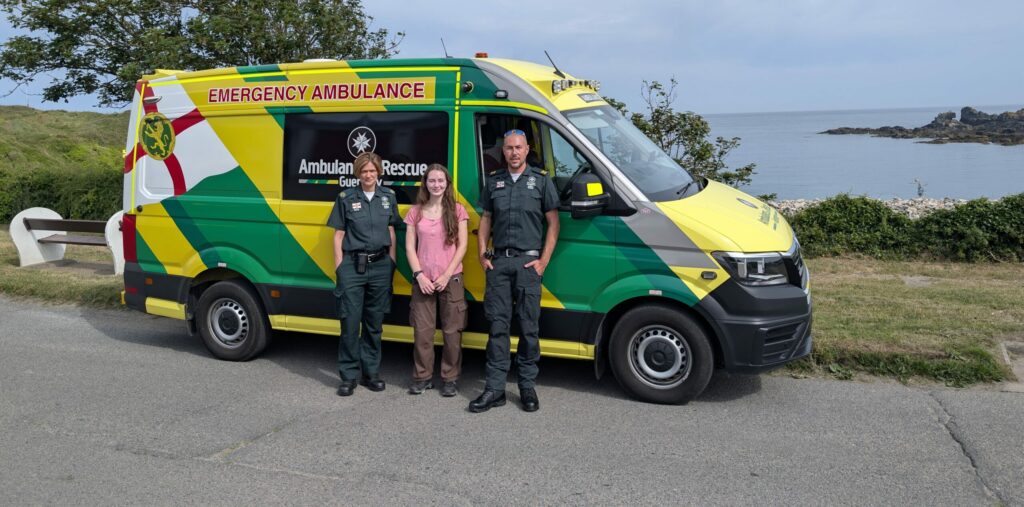
23-year-old Kenzie Bay, who studied Health and Humanism at Whitman College, spent two weeks with ambulance crews in Guernsey and Alderney for a project which compares advanced care models, with those in less well-resourced jurisdictions.
The fact-finding tour, which was funded by the Watson Foundation, also took Kenzie to Tanzania, India, Thailand, Nepal, Estonia, Norway, the U.K. and El Salvador.
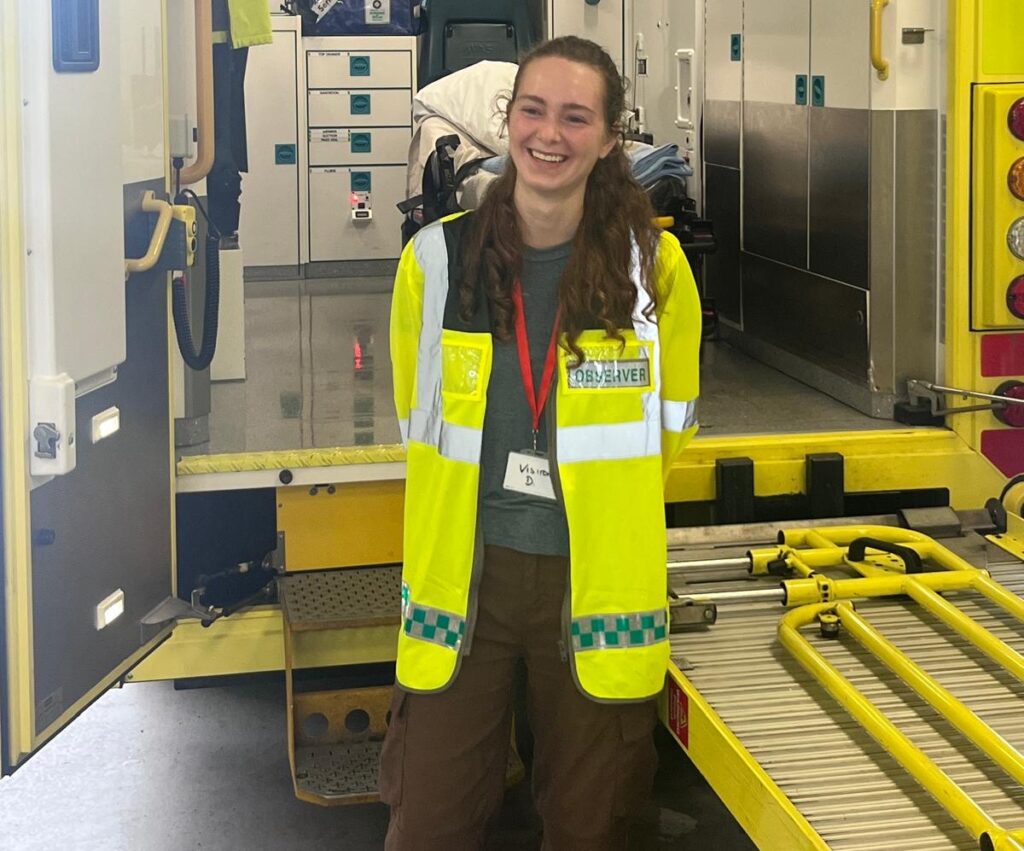
Kenzie said: “I have designed my project to learn about the delivery of care across various modes of transportation and diverse geographies, and how communities build and adapt the emergency care system to fit the environmental context.”
Reflecting on her experience in the islands she said: “The ambulance service in Guernsey is a testament to the idea that EMS is shaped by its community, it has been built and supported by its residents since the start and is specifically designed to support the Guernsey environment. The involvement of fire services, community first responders with AEDs, and the Flying Christine III are all components of extending the ambulance service’s reach and delivering care to small islands without the ease of access to a metropolitan EMS system.”
She added: “I also observed how professional relationships and patient care are influenced by community size, as relationships and rapport were often already established between ambulance, hospital, and firefighting staff, allowing for more efficient and greater continuity of care. Given the greater proportion of elderly patients in the population, exposure to this patient group was higher than I had previously experienced. I appreciated the opportunity to learn from skilled Paramedics, EMTs and ECAs who have become highly knowledgeable at assessing and managing this specific patient population with multiple comorbidities, polypharmacy, and complex social contexts.”
Kenzie also spent some time in Alderney, where the ambulance service is a satellite service provided by Guernsey’s Ambulance & Rescue Service and run by a small but dedicated team of ambulance crew. This was the smallest healthcare system of all those she visited.
“Alderney was a fascinating environment to learn from, as the EMS system has to plan around a higher level of uncertainty and preparedness while balancing the appropriate level of staffing and resources for the community’s size. The island occupies a difficult position in systems development as it is too large to rely primarily on a community first responder model like Sark or Herm, yet too small to warrant the level of services present in Guernsey. Determining the level of resources in Alderney is further complicated by the island’s need for external assistance in the event of high-acuity cases, along with the consideration that access to external resources may be delayed by weather or other operational constraints. While navigating this geographical tension is not necessarily unique it is a good example of geography remaining a pivotal determinant of emergency care requiring resiliency of resources to mitigate its impact and ensure equitable access to emergency care
“What also interested me about Alderney was that it illustrated how scope of practice is often determined by contextual evaluation, rather than being standardised. Compared with Guernsey, ambulance staff practice with greater autonomy and scope because the environment requires such flexibility in protocols. This is an excellent example within my project of how geographic challenges, delayed access to definitive care, and limited local resources can necessitate broader decision-making responsibilities. Providers in Alderney must also balance clinical readiness and clinical exposure and work to maintain proficiency in low-frequency, high-acuity events,” she added.
During her time in Guernsey and Alderney Kenzie attended joint training between the ambulance and fire service, involving complex patient extrication, and pit-stop CPR.
Away from the clinical aspect of her visit Kenzie also had the opportunity to enjoy Guernsey’s stunning coastline and beaches, going for a swim with the team after a shift which is a common shared activity for many of Guernsey’s ambulance crews.
Reflecting on her learning Kenzie draw comparisons between the Guernsey system and the charity and volunteer-driven EMS system in Thailand, as well as the public-private partnership in India.
“From the standpoint of a high-income island environment, Guernsey is a great example of a proportionally designed system, with an approach heavily focused on scale, geography, and community needs. The system in Guernsey is about building and maintaining a system that strikes the right balance: enough resources but not too many, enough scope and specialization but not excessive; and not at the cost of generality,” she said.
“While many countries are preparing for and beginning to feel the effects of an aging population, Guernsey is already experiencing this in its day-to-day operations. Ambulance staff have honed their assessment of frailty, polypharmacy, and complex comorbidities. They are aware of the complexities and pitfalls of prehospital care and social services when managing a growing number of elderly patients. Therefore, providers in Guernsey may have useful insights into the challenges that many ambulance services will increasingly face over the coming decades.”